Handshakes at Altitude: What American Buyers Are Really Testing on the Factory Floor

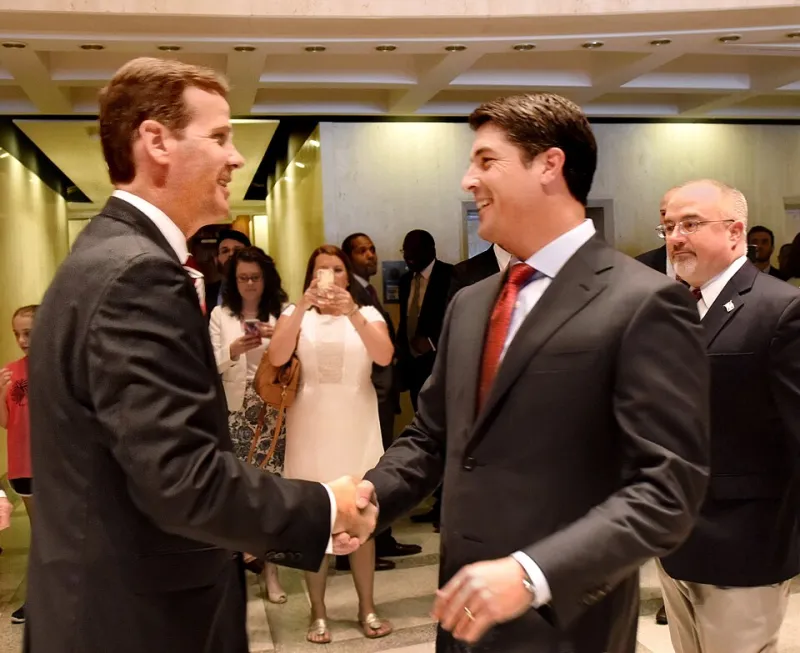
Photo: business handshake factory floor industrial meeting international trade, via as2.ftcdn.net
The video conference was flawless. The supplier's operations manager had prepared slides, walked through the production line on a gimbal-mounted phone, and answered every technical question in crisp, machine-assisted English. Six weeks later, a Midwest-based kitchenware importer signed a seven-figure purchase agreement — and then booked a flight anyway.
Why? As the company's procurement director put it over coffee in Dongguan: "The screen told me they had a factory. The trip told me they had a business."
That distinction — between what a camera can verify and what only presence can confirm — is quietly shaping how American small and mid-sized enterprises allocate their sourcing budgets in 2025.
The Audit You Can't Schedule
Formal factory audits exist for a reason, and third-party inspection firms do solid work. But veteran importers describe a parallel, unstructured assessment that happens only in person: the state of the employee parking lot, whether the warehouse foreman greets the owner by name or by title, how the cafeteria food smells at 11 a.m.
One Ohio-based hardware distributor, who asked to be described only as a buyer of fasteners and fittings, keeps a mental checklist that has nothing to do with ISO certificates. "I watch how a supervisor corrects a worker on the line," he says. "Respectful correction means low turnover. Low turnover means consistent quality. You cannot see turnover on a Zoom call."
Suppliers, for their part, read the visit back. A family-run injection molding operation outside Ho Chi Minh City notes which American clients send someone who lingers on the floor versus someone who signs in the conference room and leaves. The ones who linger, the owner says, "have already decided to stay five years. We invest differently in them."
What the Flight Actually Buys
Strip away the romance and the trade mission is a due-diligence instrument with an unusually high price tag — typically $4,000 to $9,000 per person for a two-week Asia circuit, depending on season and routing. Buyers who make the trip consistently describe three returns on that spend:
Speed of escalation. When a shipment goes sideways — a mold cracks, a container fails inspection — the supplier's response time is measurably faster for the client whose face the general manager remembers. Several importers describe problems solved in days that, for anonymous accounts, drag on for weeks.
Access to the real decision-maker. Video calls route through sales staff. An in-person visit, particularly one timed around a regional trade fair or the Lunar New Year season, tends to end with the owner at the table. Terms discussed with owners stick; terms discussed with intermediaries drift.
Calibration of risk. Perhaps most valuable is the intuitive sense of whether a supplier is stretched. Order books visible on a shelf, overtime schedules on a whiteboard, the age of equipment on the floor — these are the early-warning signals that no dashboard surfaces reliably.
When the Screen Is Genuinely Enough
None of this argues that every relationship requires a passport. There are circumstances, buyers and suppliers agree, where virtual engagement is not merely acceptable but sensible.
Repeat orders on established specifications, for instance. If the tooling is proven, the quality history is clean, and margins are thin, the marginal value of another visit is low. Similarly, commodity-adjacent purchases with multiple qualified alternatives — where switching costs are measured in weeks — rarely justify travel.
A pragmatic rule of thumb emerging among experienced American importers: fly before the first major commitment, fly when something breaks, and fly when the relationship is about to deepen — exclusivity, tooling investment, or a multi-year volume agreement. Between those milestones, video suffices.
The New Etiquette of Presence
The visit itself has evolved. Buyers increasingly pair factory tours with a stop at the supplier's key sub-vendors, recognizing that tier-two capacity is where many disruptions actually originate. Trade associations and state export-promotion offices have responded, organizing group missions that spread fixed costs across several member companies — a practical lifeline for the SME that cannot justify a solo trip.
Translation technology, ironically, has strengthened rather than replaced the in-person meeting. With AI handling the mechanics of language, the human hours on site are freed for the things machines still cannot grade: whether promises come easily, whether problems are volunteered or extracted, whether the numbers on the quote survive contact with the shop floor.
The Ledger Closes Both Ways
Suppliers are watching too. Several Asian manufacturers now quietly rank their American clients by engagement, prioritizing capacity during shortages for the buyers who showed up. In an era when everyone claims to be a "long-term partner," the willingness to spend two days in transit remains the cheapest credible signal on the market.
The kitchenware importer from the Midwest offers the closing thought. Standing on the supplier's floor, he had noticed a second, smaller production line running product for a competitor. Rather than a red flag, the discovery became leverage — and ultimately, a better allocation commitment for his own orders.
"You can't find that in a shared spreadsheet," he says. "You find it by being in the room. Or in this case, the building."
At Shumpein Global Trading, we've seen this pattern hold across dozens of sourcing relationships: technology compresses distance, but it has not yet repealed the arithmetic of trust. The seven-thousand-mile handshake endures because, for decisions measured in seven figures, it remains the least expensive way to know what you're buying into.