Duty Deferral, Not Duty Evasion: Designing a Foreign Trade Zone Program That Survives an Audit
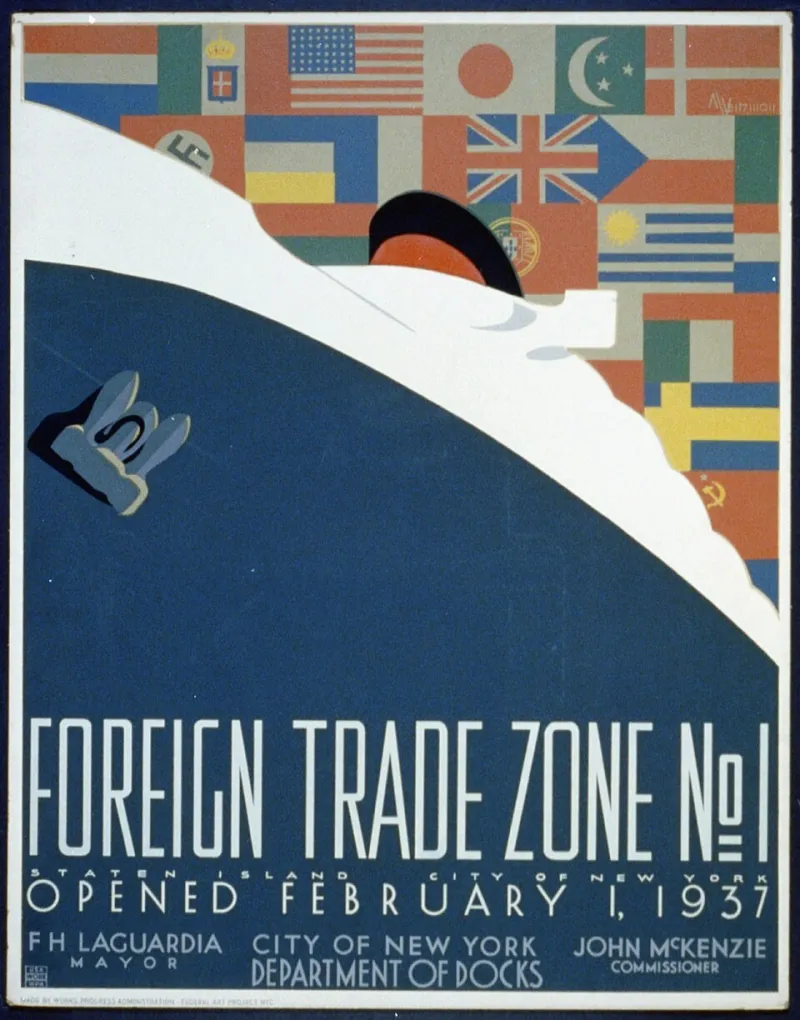
Photo: Work Projects Administration Poster Collection, Public domain, via Wikimedia Commons
Foreign Trade Zones often enter a mid-sized importer's planning discussion through the promise of lower duties. That promise is real, but incomplete. An FTZ is not a hiding place for imported merchandise, nor a method for avoiding lawful customs obligations. It is a controlled customs procedure that allows qualified companies to delay, reduce, or in limited cases eliminate duties—provided they can prove, document by document and unit by unit, that every movement of merchandise was authorized.
For American importers, the distinction matters. The Foreign Trade Zones Act dates to 1934, and the program has long been administered through a partnership between U.S. Customs and Border Protection and local grantee organizations. Its durability comes from discipline, not from leniency. Companies that treat an FTZ as a cash-flow instrument tend to benefit. Companies that treat it as a shortcut tend to attract penalties.
What an FTZ Actually Does—and Does Not Do
An activated FTZ site is generally considered outside U.S. customs territory for duty purposes. Imported merchandise may be admitted into the zone before formal customs entry, allowing the importer to defer duty until goods are transferred into U.S. commerce. If merchandise is re-exported, destroyed under approved procedures, or otherwise never enters domestic consumption, duty may not be owed at all.
The program also permits inverted-tariff treatment in certain circumstances: when the duty rate on imported components is higher than the rate on the finished product, the finished product's rate may apply upon entry. For distributors, a more common benefit is weekly entry, which consolidates numerous shipments into a single customs entry and can reduce merchandise processing fees while simplifying administration.
What an FTZ does not do is suspend the need for accurate records. Every admission, withdrawal, transfer, scrap, shortage, and reclassification must be traceable. CBP can audit zone activity, and the burden of proof rests with the operator. The zone is a privilege granted to a site and its users, not a blanket exemption from customs law.
The Seasonal Distributor's Cash-Flow Problem
Consider a fictional mid-sized distributor of seasonal goods—holiday lighting, decorative planters, and outdoor furniture—that imports most of its inventory between February and May but collects the majority of its revenue between September and December. Under conventional entry procedures, the company pays duties months before the associated sales occur. That timing strains working capital, particularly when container volumes rise and retail payment terms remain long.
By activating an FTZ warehouse, the distributor can admit goods upon arrival and defer duty until orders are picked and shipped to U.S. customers. Instead of paying duty on the full seasonal buy in spring, it pays as merchandise leaves the zone. Weekly entry further consolidates administrative work. The result is not a discount; it is a timing improvement that can free cash for inventory planning, freight, and customer credit.
The same structure can support re-exports. If a portion of the seasonal inventory is diverted to Canadian or Caribbean customers, the distributor may avoid U.S. duty on those units altogether, provided the withdrawals and export documentation are properly maintained. That outcome is legitimate only when the merchandise genuinely leaves the country under the required procedures.
Where the Compliance Traps Begin
The first trap is inventory accuracy. Zone operators must know what is in the zone, where it came from, what its customs status is, and where it went. A warehouse management system that works well for commercial purposes may not satisfy zone requirements without adaptation. Cycle counts, lot tracking, and reconciliation procedures should be designed before activation, not after the first discrepancy.
The second trap is status confusion. Merchandise in a zone can have different customs statuses, including privileged foreign status, non-privileged foreign status, and domestic status. Each affects duty treatment. Mixing statuses without clear controls can create errors that are difficult to unwind and expensive to explain.
The third trap is the weekly entry estimate. Weekly entry simplifies filing, but it requires disciplined estimated duty calculations and timely reconciliation. Underpayments and overpayments must be identified and corrected. A company that treats the estimate as a formality is building an audit finding into its process.
The fourth trap is the exception. Damaged goods, scrap, shortages, overages, and returns all require documented handling. Destroying merchandise without approval or transferring it without proper records can convert a manageable administrative issue into a penalty case. The zone's flexibility depends on the operator's ability to show that every exception followed the rules.
Designing Controls Before Activation
A practical FTZ program begins with a cost-benefit study, not a warehouse lease. Importers should model duty rates, payment timing, merchandise processing fees, inventory turns, and the cost of compliance staff or software. They should also assess whether their highest-value SKUs are suited to zone treatment and whether their suppliers can provide consistent documentation.
Activation itself involves coordination with the local grantee, CBP, and often outside counsel. Security requirements, bonding, record-keeping systems, and employee training should be addressed in sequence. A written operations manual—covering admissions, withdrawals, inventory control, reconciliation, and exception handling—is not bureaucratic decoration. It is the operating system of the zone.
At Shumpein Global Trading, we see FTZ planning as part of the broader discipline of connecting markets responsibly. The importers who gain the most are rarely the ones seeking the most aggressive interpretation. They are the ones who can explain their supply chain clearly, document it consistently, and correct errors before an auditor discovers them.
Is an FTZ Worth It?
An FTZ is not suitable for every mid-sized importer. Companies with low duty exposure, short cash cycles, or limited administrative capacity may find that the compliance burden outweighs the benefit. For seasonal distributors and others with high duty payments and long inventory holding periods, however, a well-designed zone can improve liquidity and landed-cost visibility without inviting enforcement risk.
The central question is not whether an FTZ can reduce duty. It is whether the importer can prove, at any moment, that every unit in the zone is exactly where the records say it is. Companies that can answer yes have found a strategic tool. Companies that cannot should fix their controls before they pursue the designation.